
A portable power station is the right choice if you need backup power for essentials during short outages or for camping and off-grid use. A whole-home backup battery system is the right choice if you want to keep your entire house running through extended outages or want to go fully off-grid. The difference comes down to how much power you need, for how long, and what you're willing to spend.
Power outages are getting longer and more frequent across the US. Whether you're in a storm-prone area, running a home workshop that can't go dark, or just tired of losing your fridge full of food every time the grid goes down — this guide will tell you exactly which system makes sense for your situation.
The Core Difference: Scale and Purpose
Think of it this way:
- A portable power station is like a giant rechargeable battery pack — quiet, clean, no fumes, no fuel. Great for powering lights, phones, a TV, a CPAP machine, a mini fridge, or a few power tools for hours at a time.
- A whole-home backup battery system is a permanent installation — wall-mounted or rack-mounted LiFePO4 battery banks that power your entire electrical panel. Think of it as a silent whole-home generator that never needs fuel.
Neither is better than the other — they solve different problems at different price points.
Portable Power Stations: Who They're For
A portable power station makes sense if you need any of the following:
- Backup power for essentials during outages lasting a few hours to a day
- Power for camping, overlanding, or tailgating
- A clean, quiet power source for a home office or workshop
- Emergency power that you can take with you if you evacuate
- A way to run specific appliances — fridge, medical equipment, lights — without powering the whole house
What to Look For in a Portable Power Station
Capacity (Wh): Watt-hours tell you how much total energy the station stores. A 1,000Wh station can run a 100W device for about 10 hours, or a 500W device for about 2 hours. For serious home backup, look for 2,000Wh or more.
Output (W): This is how many watts the station can deliver at once. A 2,000W output station can run most refrigerators, a TV, lights, and phone chargers simultaneously. Make sure the output exceeds the combined wattage of what you plan to run.
Battery chemistry: LiFePO4 (lithium iron phosphate) batteries are the gold standard — safer, longer lifespan (3,000–5,000 cycles vs. 500 for older lithium-ion), and more stable in high temperatures. Always choose LiFePO4 for any serious backup use.
Solar input: Most quality stations accept solar panel input so you can recharge off-grid. Check the maximum solar input wattage — higher is better if you're planning extended off-grid use.
Top Portable Power Stations at Garage Gear Direct
Jackery Explorer Series — One of the most popular and reliable portable station brands. The Explorer 2000 Pro and Explorer 3000 Pro are ideal for serious home backup and extended camping use. Clean design, fast solar charging, and excellent build quality.
Anker SOLIX Series — Anker's SOLIX line is built for heavy-duty use with LiFePO4 chemistry throughout. The SOLIX C1000 and C2000 are workhorses — fast charging, high output, and designed to be expanded with additional battery units.
Arkpax Ark PRO 2400W — IP67 waterproof rating makes this the go-to for anyone using it outdoors, in a garage, or in demanding conditions. 2,400W output handles most home essentials with room to spare.
Nature's Generator Lithium 3600 — One of the most complete off-grid solutions available. Pairs with solar panels and a wind turbine for true energy independence. The 3,600Wh capacity handles extended outages comfortably.
Browse All Portable Power Stations at Garage Gear Direct →
Whole-Home Backup Battery Systems: Who They're For
A whole-home LiFePO4 battery system makes sense if you need any of the following:
- Backup power for your entire home through outages lasting 12+ hours
- A permanent off-grid or grid-tied solar storage solution
- Power for a home with well water (pump requires significant wattage)
- Backup for electric vehicle charging, HVAC systems, or large appliances
- A long-term investment that pays back through lower energy costs
What to Look For in a Whole-Home Battery System
Total capacity (kWh): The average US home uses about 30 kWh per day. A system that can cover 1–2 days of outage needs 30–60 kWh of storage. Start by calculating your critical loads — fridge, lights, HVAC, water pump — and size from there.
Voltage and configuration: Most whole-home systems run at 48V. Battery banks are built by connecting multiple modules — the more modules, the more capacity. Make sure the system you choose is expandable so you can add capacity later.
BMS (Battery Management System): A built-in BMS protects the battery from overcharging, over-discharging, and temperature extremes. This is non-negotiable for any permanent installation.
Inverter compatibility: Whole-home battery systems need to be paired with an inverter to convert DC battery power to AC household power. Make sure the battery and inverter are compatible before buying.
Top Whole-Home Battery Systems at Garage Gear Direct
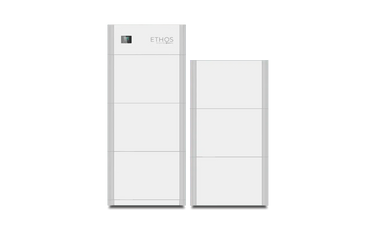
BigBattery 48V ETHOS Series — The flagship whole-home solution at Garage Gear Direct. Available in configurations up to 30.7kWh (6 modules), the ETHOS is built for permanent installation with a robust BMS, Bluetooth monitoring, and excellent cycle life. This is what serious off-grid homeowners and preppers choose.
Epoch Batteries 48V 120Ah GC2 Golf Cart LiFePO4 — A proven LiFePO4 solution for both golf cart and home energy storage applications. Includes Bluetooth monitoring and control, making it easy to track state of charge and system health from your phone.
Browse Whole-Home Battery Systems at Garage Gear Direct →
Side-by-Side Comparison
| Portable Power Station | Whole-Home Battery System | |
| Best for | Short outages, camping, portability | Extended outages, whole-home backup |
| Typical capacity | 500Wh – 5,000Wh | 10kWh – 60kWh+ |
| Installation | None — plug and play | Professional installation required |
| Portable | Yes | No — permanent installation |
| Typical cost | $500 – $5,000 | $3,000 – $20,000+ |
| Solar compatible | Yes — most models | Yes — designed for solar pairing |
| Runs whole home | No — selected appliances only | Yes |
| Best brands | Jackery, Anker SOLIX, Arkpax, Nature's Generator | BigBattery, Epoch Batteries |
Which One Should You Buy?
Buy a portable power station if: You want backup for essentials, you need something portable, your budget is under $3,000, or you're primarily using it for camping and outdoor activities alongside home backup.
Buy a whole-home battery system if: You've experienced multi-day outages, you have a well pump or medical equipment that can't go offline, you're pairing with solar panels, or you're serious about energy independence.
Buy both if: You want whole-home coverage AND the flexibility of a portable unit you can take camping or keep in your vehicle for emergencies. Many Garage Gear Direct customers do exactly this — a BigBattery ETHOS system for the house and a Jackery or Anker SOLIX for the truck or RV.
Not sure which setup is right for your home? The Garage Gear Direct team can walk you through sizing a system based on your specific appliances and outage risks. Call or reach out at (970) 699-4343.
Shop All Backup Power & Off-Grid Gear →
Shop Gas & Dual-Fuel Generators →
Frequently Asked Questions
What is the difference between a portable power station and a whole-home backup battery?
A portable power station is a self-contained rechargeable battery you can move around and use for selected appliances during outages or off-grid. A whole-home backup battery system is a permanently installed LiFePO4 battery bank that powers your entire electrical panel through extended outages.
How long will a portable power station last during a power outage?
It depends on the station's capacity and what you're running. A 2,000Wh station running a refrigerator (150W), lights (50W), and phone chargers (30W) would last roughly 8–10 hours. Pairing with solar panels extends that indefinitely during daylight hours.
What is LiFePO4 and why does it matter?
LiFePO4 (lithium iron phosphate) is a battery chemistry that is safer, longer-lasting, and more thermally stable than standard lithium-ion. Quality backup power systems use LiFePO4 because it delivers 3,000–5,000 charge cycles versus 500 for older lithium-ion chemistry — meaning a 10-year lifespan versus 2–3 years with daily use.
How many kWh do I need for whole-home backup power?
The average US home uses about 30 kWh per day. For critical loads only — fridge, lights, water pump, and internet — you can often get by with 10–15 kWh. For full home coverage through a 24-hour outage, plan for 25–35 kWh minimum.
Can I pair a portable power station with solar panels?
Yes. Most quality portable power stations accept solar panel input. The Anker SOLIX, Jackery Explorer, and Nature's Generator lines all support solar charging. Pair with Anker SOLIX 440W rigid solar panels for the fastest recharge times.